
How NRIs Can File ITR in India Without Stress: A Step-by-Step Guide for Global Professionals
How NRIs Can File ITR in India Without Stress: A Step-by-Step Guide for Global Professionals. Filing your Income Tax Return (ITR) in India as a Non-Resident Indian (NRI) can feel like navigating a labyrinth. Especially when you’re juggling international income, foreign investments, and deadlines across time zones. But it doesn’t have to be stressful. With the right step-by-step strategy, you can file your ITR accurately, optimize taxes, and even save money legally—all without the headache.
TAX OPTIMIZATION
Smart Life Money
8/9/2025
How NRIs Can File ITR in India Without Stress: A Step-by-Step Guide for Global Professionals
Filing your Income Tax Return (ITR) in India as a Non-Resident Indian (NRI) can feel like navigating a labyrinth. Especially when you’re juggling international income, foreign investments, and deadlines across time zones. But it doesn’t have to be stressful. With the right step-by-step strategy, you can file your ITR accurately, optimize taxes, and even save money legally—all without the headache.
If you are earning more than ₹36 lakh annually abroad, this guide is crafted just for you. It’s practical, real-world, and designed for global professionals who want compliance, clarity, and tax efficiency.
1. Understand Who Qualifies as an NRI for Tax Purposes
Before diving into forms and numbers, it’s essential to clarify your residential status, as it dictates your tax obligations in India:
Resident & Ordinarily Resident (ROR): Global income taxable in India.
Resident but Not Ordinarily Resident (RNOR): Only Indian income taxable.
Non-Resident Indian (NRI): Only Indian-sourced income taxable.
Pro Tip: Many NRIs assume they’re exempt from filing ITR if their income is primarily abroad. Incorrect! You may still owe taxes on Indian investments, rental income, or capital gains.
2. Gather All Required Documents Before Filing
Nothing is more stressful than starting an ITR with scattered documents. Here’s a preparation checklist for NRIs:
PAN card and Aadhaar (Aadhaar not mandatory if abroad, but PAN is).
Form 26AS / Tax Credit Statement for Indian-sourced income.
Bank statements for NRE/NRO accounts.
Proof of foreign income (if applicable for disclosure).
Capital gains statements from stock, mutual funds, or property sales.
Rent receipts, home loan statements, and other deductions (if claiming).
DTAA certificate (if applicable, for foreign tax credits).
Tip: Use digital storage (Dropbox/Google Drive) to keep all documents in one folder—accessible from anywhere in the world.
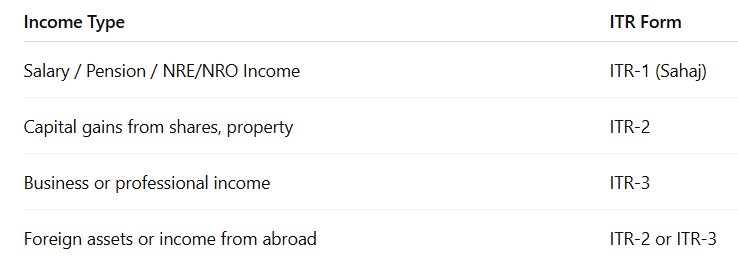
3. Identify the Correct ITR Form
Choosing the wrong form can cause delays, notices, or even penalties.
Pro Tip: High-income NRIs with multiple sources often prefer ITR-2 for a comprehensive declaration.
4. Know Your Deadlines & Avoid Penalties
For NRIs:
Normal ITR filing deadline: 31st July (for most categories)
Extended deadlines (if audit required): 30th September
Late filing fees: Up to ₹10,000
Pro Tip: Set reminders in your local time zone—don’t rely on Indian Standard Time notifications alone.
5. Use Digital Filing Platforms & Authorized E-Return Tools
Filing online saves time, ensures compliance, and provides instant acknowledgment.
Income Tax Department E-Filing Portal: The official source for ITR filing.
Authorized CA or tax advisory portals (ClearTax, Taxspanner, H&R Block India).
Digital signatures: If signing offline is not possible, e-verification via Aadhaar OTP or bank account verification works for NRIs.
Pro Tip: High-income professionals often use CA-assisted digital filing to ensure optimal tax planning and error-free submission.
6. Claim DTAA & Tax Credits to Avoid Double Taxation
If you earn abroad and pay taxes in another country, you may be eligible to avoid double taxation under the Double Tax Avoidance Agreement (DTAA).
Check whether your country of residence has DTAA with India.
Report foreign tax paid for eligible credits.
Claim foreign tax credit while filing ITR.
Real-World Example:
Ravi, an NRI in Singapore earning ₹45 lakh annually, claimed DTAA benefits while filing ITR in India. By applying the foreign tax credit, he legally reduced his Indian tax liability by ₹6 lakh in a single financial year.
7. Maximize Deductions & Tax Optimization
Even as an NRI, you can leverage certain deductions under Chapter VI-A:
80C: Life insurance, PPF (if contribution allowed for NRI), ELSS mutual funds.
80D: Health insurance for self, family, and parents.
80G: Donations to approved charities.
Tip: High-income professionals can combine deductions + DTAA credit + NRO account interest management to reduce taxable liability efficiently.
8. Cross-Check Before Submission
Errors can invite scrutiny. Always:
Verify PAN, name, and date of birth.
Reconcile income with Form 26AS.
Ensure bank accounts are correctly mentioned.
Cross-check deductions and DTAA claims.
Pro Tip: NRIs often hire a tax consultant for a final review, especially for portfolios with multiple investments or properties.
9. E-Verify Your ITR
E-verification ensures your ITR is processed quickly. Options include:
Net banking
Aadhaar OTP (if linked)
Bank account validation
Digital signature (DSC)
Without e-verification, your return is not considered filed, and notices can be sent.
10. Build a Stress-Free Annual Tax Routine
The ultimate way NRIs file ITR without stress:
Quarterly review: Track Indian income and foreign taxes.
Document collection: Maintain digital folders throughout the year.
Expert consultation: Schedule a 30-min review in advance.
ITR filing window: 1–2 weeks before deadlines—avoid last-minute stress.
Success Story:
Priya, an NRI in the UK, earning ₹60 lakh annually, started documenting her income monthly and scheduled quarterly virtual tax reviews with her Indian CA. Today, she files ITR in under 30 minutes, claims all deductions, and even receives refunds without any hassle.
Key Takeaways for High-Income NRIs
Understand residential status and Indian tax obligations.
Collect all documents digitally and early.
Use the correct ITR form and e-filing portals.
Claim DTAA benefits to save legally.
Leverage deductions & tax credits effectively.
Cross-check data, e-verify, and maintain a routine for stress-free filing.



Smart Life Money
Empowering professionals to achieve financial freedom confidently.
Investments
Planning
contact@smartlifemoney.in
© 2025. All rights reserved.